


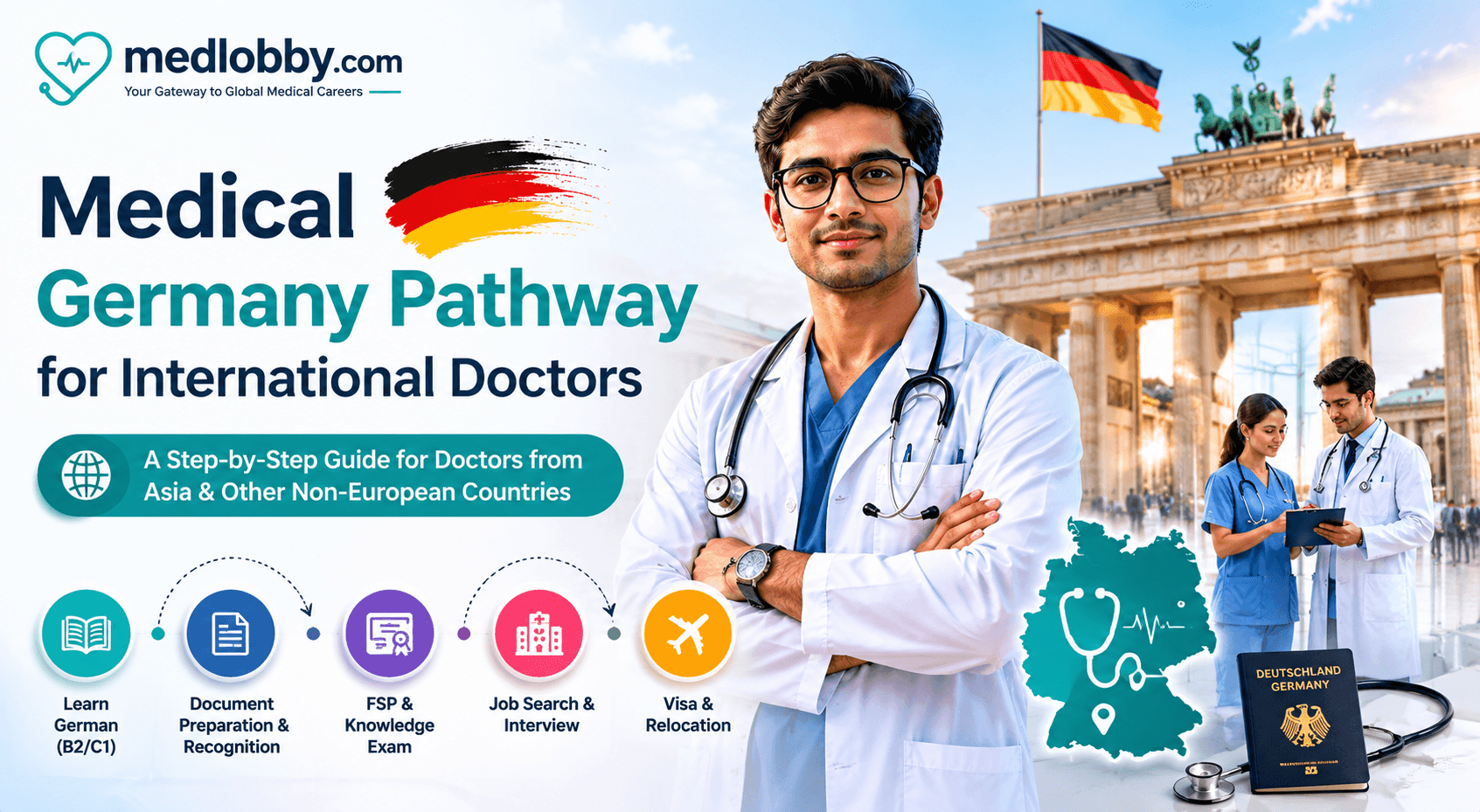
🇩🇪 Medical Germany Pathway for International Doctors
Germany has become one of the most popular destinations for international medical graduates (IMGs), especially those from Asia and other non-European countries. With a strong healthcare system, high demand for doctors, and relatively structured licensing, it offers an excellent opportunity for those with clinical experience.
1. Basic Eligibility
To start your journey, you must have:
- A recognized medical degree (MBBS or equivalent)
- Completed internship or clinical experience
- Willingness to learn German (this is essential)
Unlike some countries, Germany does not require exams like PLAB or USMLE initially, but language and licensing are key.
2. Learn German (Most Important Step)
You must reach at least:
- B2 level (general German)
- C1 medical German (Fachsprachprüfung – FSP)
Without proper language skills, you cannot work or interact with patients. Most candidates spend 6–12 months achieving this level.
3. Document Preparation & Recognition
You will need to prepare:
- Medical degree
- Transcript
- Internship certificate
- Good standing certificate
- CV (German format)
These documents are submitted to a German state authority for evaluation (called the Approbation authority).
4. Apply for Approbation or Temporary License
There are two main pathways:
a) Temporary License (Berufserlaubnis)
- Allows you to start working under supervision
- Valid for a limited time
- Easier to obtain initially
b) Full License (Approbation)
- Permanent license to practice independently
- Requires passing exams if your degree is not fully equivalent
5. Fachsprachprüfung (FSP)
This is a medical German exam that tests:
- Patient communication
- Doctor-to-doctor discussion
- Medical documentation
It is usually the first exam you must pass after reaching B2/C1 level.
6. Knowledge Exam (Kenntnisprüfung – KP)
If your degree is not considered equivalent, you will need to pass this exam.
It tests:
- Internal medicine
- Surgery
- Clinical knowledge
Doctors with prior clinical experience often find this manageable with preparation.
7. Job Search in Germany
Once you have:
- B2/C1 German
- FSP (or preparing for it)
You can apply for jobs such as:
- Assistant Doctor (Assistenzarzt)
Germany has a shortage of doctors, so opportunities are widely available, especially in smaller cities.
8. Visa & Relocation
After receiving a job offer:
- Apply for a work visa
- Relocate to Germany
- Start working while completing remaining requirements (if any)
💡 Final Thoughts
Germany offers a structured and achievable pathway for international doctors. While the language requirement is challenging, it replaces the need for multiple licensing exams seen in other countries.
For doctors with clinical experience, the transition is smoother, and career growth is strong once you enter the system.
With the right planning and consistency, working as a doctor in Germany is a realistic and rewarding goal.
Discussion
Leave a Comment